

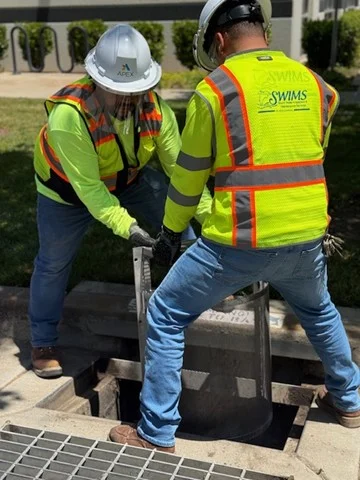
If you are evaluating full capture devices for your storm water system, the connector pipe screen vs. catch basin insert decision is one of the most important choices you will make. Both devices are designed to capture trash and debris before they reach local waterways, but they work differently, install differently, and perform differently depending on your site conditions. SWIMS has installed thousands of both device types across California, and our field experience gives us a perspective that goes beyond product spec sheets. Here is what you need to know to make the right call for your project.
How a Connector Pipe Screen Works (Outlet-Side Capture)
A connector pipe screen (sometimes called a CPS) is a full capture device that installs inside the catch basin at the outlet pipe. Instead of filtering water as it enters the basin, the screen captures trash and debris at the point where water exits toward the storm drain system. Think of it as a last line of defense before anything reaches downstream infrastructure.
The StormTek™ Connector Pipe Screen, manufactured by SWIMS, is a California State Water Board-certified full capture device that has been proven in the field since 2007. It is precision-fabricated from stainless steel to fit each unique pipe configuration, and no two installations are exactly alike, and that custom fit is what makes the device effective over the long term.
Here is how the StormTek™ CPS works in practice:
- The screen sits inside the catch basin, mounted over the connector pipe opening
- Water flows through the screen mesh while trash, sediment, and debris are retained inside the basin
- The device features a hinged lid and tool-free removal from its frame, so maintenance crews can pull it, clean it, and reinstall it without specialized equipment
- Because the screen captures material at the outlet, the catch basin itself acts as the storage area for captured debris
This outlet-side approach has a practical advantage: it works with your existing catch basin infrastructure rather than requiring you to retrofit the inlet.
How a Catch Basin Insert Works (Inlet-Side Capture)
A catch basin insert takes the opposite approach. It sits at the top of the catch basin, typically beneath the grate, and filters water as it enters the structure. Debris is captured in a tray, basket, or filter bag before water reaches the basin below.
Catch basin inserts come in many configurations from various manufacturers. Some use fabric filter bags, others use rigid trays with screen mesh, and some incorporate absorbent media for oil and grease removal. The common thread is that they all intercept flow at the inlet side of the catch basin.
Because inserts sit directly beneath the grate, they are exposed to the full volume and velocity of surface runoff as it enters the basin. This means they can fill up faster, especially during high-flow storm events or in areas with heavy leaf litter, sediment, or urban debris. When an insert reaches capacity, water can bypass the device entirely, which reduces its effectiveness until the next maintenance visit.
That said, catch basin inserts have their place. They are relatively straightforward to install, widely available, and can be a good fit in certain low-flow or low-debris environments where maintenance intervals are frequent enough to prevent bypass.
Connector Pipe Screen vs. Catch Basin Insert: Performance, Maintenance, and Cost
When property managers and municipal agencies ask us to compare a connector pipe screen vs. catch basin insert, the conversation usually comes down to three factors: performance during storm events, maintenance burden, and total cost of ownership over time.
Performance During Storm Events
A connector pipe screen allows water and debris to enter the catch basin freely and captures material at the outlet. This means the full volume of the basin is available as storage capacity. During heavy rain events, which are becoming more common and more intense across California, that extra capacity matters. The basin does not back up or overflow as quickly because the device is not restricting inflow at the surface.
A catch basin insert, by contrast, restricts flow at the inlet. When a high-intensity storm pushes a large volume of water and debris onto the grate, the insert can become overwhelmed. If the filter media clogs or the tray fills, water bypasses the device and enters the basin unfiltered. In regions with significant seasonal debris loads (think fall leaf drop in Northern California or post-fire sediment in Southern California), this bypass risk is a real operational concern.
Maintenance Requirements
Both device types require regular maintenance, but the experience is different. A connector pipe screen like the StormTek™ is designed for fast service: tool-free removal, a hinged lid, and a design that lets a single technician complete the job efficiently. The catch basin itself holds captured debris between service visits, so the device does not need to be cleaned as frequently as an insert that fills up at the surface.
Catch basin inserts typically require more frequent service intervals because their smaller capacity means they fill up faster. Depending on the site, that could mean monthly or even bi-weekly cleaning during peak debris seasons. Over time, those additional service visits add up, not just in direct maintenance costs, but in scheduling coordination and site access logistics.
Total Cost of Ownership
The upfront cost of a connector pipe screen can be higher than a basic catch basin insert, because each CPS is custom-fabricated to fit the specific pipe dimensions at your site. But when you factor in fewer maintenance visits, longer intervals between cleanings, and better storm event performance, the total cost of ownership over a five- to ten-year period often favors the connector pipe screen, especially for sites with moderate to heavy debris loads.
We encourage every client to look beyond the purchase price and consider the full lifecycle cost. A device that requires less frequent maintenance and performs reliably during the events that matter most will almost always deliver better value over time.
When Each Device Is the Better Fit
So what is the difference between a connector pipe screen and a catch basin insert in terms of where each one belongs? It depends on your site conditions, your maintenance capacity, and your compliance goals.
The connector pipe screen benefits are most evident when:
- Your site has moderate to heavy debris loads: urban litter, leaves, and sediment
- You need reliable performance during high-intensity California storm events
- You want to reduce maintenance frequency and simplify service logistics
- Your catch basins have connector pipes that can accept a custom-fitted screen
- Long-term cost efficiency is a priority over lowest upfront cost
A catch basin insert may be the better fit when:
- Your site has low debris loads and consistent, low-volume flows
- You have the maintenance capacity for frequent cleaning intervals
- Your catch basin configuration does not have a standard connector pipe
- You need a temporary or interim solution while planning a longer-term approach
The reality is that many sites benefit from a combination of approaches: connector pipe screens on high-priority outfalls and catch basin inserts in lower-risk areas. A full capture device comparison should always start with a site-specific assessment rather than a blanket recommendation.
SWIMS has installed both device types across California for over two decades. We are not a manufacturer trying to sell you one product — we are a full trash capture service provider that recommends the right device for your specific conditions.
California Certification Requirements for Both Device Types
If you are installing a full capture device in California, certification is not optional — it is a compliance requirement. The California State Water Resources Control Board maintains a list of certified full trash capture devices, and only devices on that list satisfy the state’s trash capture mandates under the CASQA-aligned framework for municipal storm water permits.
The StormTek™ Connector Pipe Screen has been on that certified list since 2006, one of the longest-standing certifications of any full capture device in California. That matters because certification is not just a one-time checkbox. It represents a track record of verified performance in real-world conditions.
Not all catch basin inserts carry the same certification. Some are certified as full capture devices, while others are classified as partial capture or treatment controls. The distinction matters more than most people realize. A partial capture device may reduce trash loads, but it will not satisfy full capture requirements under your municipal storm water permit. If your municipality has adopted a full capture mandate, only a certified full capture device will keep you in compliance.
Before you purchase any device, confirm that it appears on the State Water Board’s certified device list and that it meets the specific requirements of your local municipal storm water permit. Your regional water quality control board may have additional guidance on approved devices and installation standards, and those requirements can vary from one jurisdiction to the next.
With the 2030 full trash capture deadline approaching for municipalities across California, getting this right now, rather than scrambling later, gives you more time to plan installations, budget for maintenance, and avoid the rush that will come as the deadline gets closer.
How to Get Started with the Right Device for Your Site
Choosing between a connector pipe screen and a catch basin insert does not have to be complicated, but it does require site-specific information. Pipe dimensions, debris loads, flow volumes, existing infrastructure, and local permit requirements all factor into the recommendation.
SWIMS starts every full trash capture project with a site assessment, either an on-site visit or guided self-measurement instructions, so the recommendation is based on your actual conditions, not assumptions. From there, we handle fabrication, installation, and ongoing maintenance under one relationship.
If you are a property manager, municipal agency, or facility owner evaluating connector pipe screen California options or comparing trash capture device types for your storm water system, SWIMS can help you make the right choice and back it up with 26+ years of field experience. Contact SWIMS today to schedule your storm water system evaluation — call (866) 967-9467 or visit swimsclean.com/contact to get started.